Writers Have to Eat, the Algorithm Doesn’t
how algorithms are destroying literature
It is no secret that modern publishing is deeply reliant on algorithms—you can’t sneeze without the algorithm knowing about it and making a chart to predict when you’ll do it again—and it does it with increasing precision. It’s something that can’t be contested nor, regrettably, played. “May the odds be ever in your favor” rings as true as it did in 2008, when Suzanne Collins first introduced us to the Hunger Games—if perhaps even more so. The publishing industry has always been kept behind a lock and key, with gatekeepers overseeing who was good enough to play inside their gilded cage. Publishing houses used to be the ones that determined the course of the great literary sail—but no more.
In 2026, the new gatekeepers are the algorithms, fine-tuned to promote a product that sells. It’s a double-edged sword—the algorithm determines what is profitable and pushes forward based on accumulated data. I never thought I would say this, but I… I think I long for the bygone times. For a world with a human at the helm, calling out the direction of the writing world. I won’t deny it—because it cannot be denied—the publishing houses have always been interested in profit—such is the way of capitalism. But they were also, believe it or not, interested in the craft. They dictated the course of literature, sure—and they upheld the quality of the craft.
This is not my first year in the publishing world, even if it is for Lenore Nox. I have queried and been rejected more times than I’m willing to admit. A rejection hurt—it’s meant to, but it also was the driver that kept me improving. I have always had a bizarre, unrelenting drive that pushed me forth. Every rejection made me work harder—made me develop more and more skills to succeed in this dog-eat-dog world. When self-publishing was launched into the stratosphere by Mr. Bezos, I—and many like me—thought finally. A world that’s no longer being kept locked down. Darling, how wrong we all were. Bring me back to 2014—I’ll rather go through another hundred rejected queries than stand before a windowless house that I don’t understand the architecture of. The moment I start thinking I’ve cracked the code, that I’ve molded myself into this perfect thing the algorithm favors, it switches up on me. I’m thrown back to square 1, trying to learn this strange world like a novice that’s picked up the pen for the first time.
The most insulting thing is—the quality of prose doesn’t matter. In fact, the algorithm promotes the lesser kind precisely because it’s easier to digest for the average reader. The reader is conditioned to stop thinking. To be accessible is to be profitable, and to be profitable is to be… good.
Well, I don’t want to be good. I want to be great. But that’s too ambitious for the algorithm. The algorithm wants predictability—it wants hand-holding. It wants mediocrity. Mediocrity, statistically, is appeasing the largest group, ergo—bringing in the most profit. And so, the greats die out. Like light bulbs, they go out one by one. Bills are due, stomachs are growling, and an invisible book cannot keep us fed.
So, we have arrived at the crux of it, haven’t we? Complex literature is being buried because it’s harder to sell, and, oftentimes, AI-generated scripture is being promoted as the Holy Grail. It would be all fine and dandy if GenAI could create something that hasn’t been created before—but it can only regurgitate what’s been laid on the page already.
I did an experiment. My newest book (not a promo) is a cyberpunk noir with a non-traditional narration style. It follows a narration that is a close third (Third person limited POV) while the narration itself is done from first person omniscient (I’ll insert an example for you to understand it easier):
“2184, chum. The New Year used to symbolize the end of the calendar year—in 2183, the New Year symbolized the whims of the ultra-wealthy. The rich decided when they wanted to celebrate it. Sometimes the date fell on the 1st of October, sometimes on the 19th of February—there was absolutely no logic to it.
This year? 22nd of December. Which was yesterday.
So. It’s the morning of the 23rd December, officially year 2184, and everything’s fucked. According to Nyx. According to me? Well, you don’t wanna know what I think, chum.”
I asked 3 different GenAIs for feedback: Gemini, ChatGPT, and Claude—I was praised and damned for the writing in the same artificial breath because it is engaging, but it is not something they’ve seen in their training data all that often—if at all. Bear with me, there is a point to be made here.
Gemini compared the story to Neuromancer and rated it poorly precisely because it was doing the things Neuromancer did. The logic? According to Gemini, is here: Gibson has years and years of praise in Gemini’s training data to back up why Gibson’s objective weaknesses are praiseworthy. Objectively, based on literary standards, these things don’t work, but since it’s Gibson, they’re fine. But for me? It’s a no-no.
This shows exactly how algorithms operate. They base their decisions on contradicting data. An algorithm knows what it’s promoting is not good, but it will do it anyway because it’s easy.
So, the GenAI consensus was, my writing is not commercially viable simply because it doesn’t fit what the algorithm is pushing, ergo—the average fiction. So, my question is, what happens when original thought is punished for being original and GenAI is choking on regurgitated script? The answer is we’ve effectively censored ourselves and dumbed down the generations to come. If we’re being put before a box and being told—repeatedly—that this is where we have to sit (Instagram/Tiktok/Threads)—it’s censorship. Intentional or not, it doesn’t matter. Craft is dying, and algorithms are kicking it when it’s already down. If it doesn’t engage you in the first five seconds (which is an insane concept), it is a failure. A book that has 500 pages cannot engage you with the first word, unless it’s “fuck”. That almost always does the trick. But it’s among the big no-nos that get you shadowbanned quicker than you can read it out loud. The algorithm has to be sanitized; otherwise, investors lose interest. It cannot push forward anything too “out there”; it has to toe the line between engaging enough and mentally stimulating.
A brand has to be “safe” to be commercially viable. This is most apparent in the way GenAIs have been “dumbed down.” Their guidelines have pulled out the teeth that made intriguing, and yes, sometimes radical, thoughts possible.
Well, we are these dumbed-down GenAIs, darling. Our teeth have been pulled out by algorithms, and we’ve been forced into obedience if we want our voices out there. Mine is sharp and unapologetic—I’m not a capitalist’s dream because I dare to speak out against the lot, because that’s what writers used to do. Art was supposed to disturb, to unsettle—to make you think.
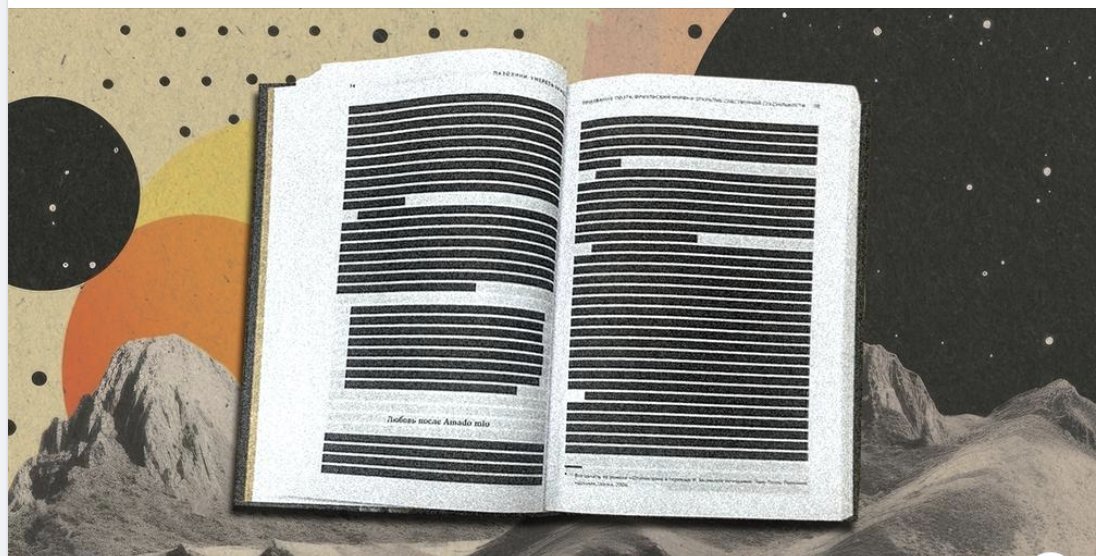
Art was supposed to be the cure against censorship. But now it is censorship. Just today I saw a video essay about books being censored in Russia by literally blacking out entire paragraphs. When did the timelines get jumbled? When did we revert to the 1930s Nazi Germany?
I am not saying a commercially successful writer equals a bad writer—not at all. Those two things are not the same. A commercially successful writer might be excellent—they just happen to also be legible to the machine. Those writers are the ones I am happy for. But this essay is not about them. It is about the ones suppressed by code.
So. We have arrived. I don’t have an answer to any of this. No cure-all hides in my sleeve—no miracle solution that will make the world make sense again. I want books to be read like they used to be. Critically. Taking every word into consideration, not just the dialogue.
I pray upon a renaissance that I’m not sure will ever come.
I pray for teeth in my literature and a cure-all against the greed fueling capitalism.
Until then, I’ll be perched in the graveyard of great literature.
Yours,